
You've invested in SEO, a few weeks have gone by, and the phone isn't ringing any more than it was. It's natural to wonder whether it's working, or whether you're paying for nothing.
Here's the honest truth: SEO is slower than most marketing, and anyone who tells you otherwise is overselling. But it's slow for good reasons, it follows a fairly predictable pattern, and there are clear signs of progress long before leads show up. This guide walks you through what to expect and when.
How long does SEO take to see results?
The first 3 months are mostly foundation work. Most businesses see early progress in 3 to 6 months and meaningful traffic and leads in 6 to 12 months. Competitive keywords and brand-new websites often take a year or more. That's why our SEO plans focus on quick wins first while longer-term rankings build.
The average #1 page is 5 years old
In Ahrefs' study of top-ranking pages for 1.3 million keywords, only 13.7% of pages in the top 10 were less than a year old (Ahrefs, 2025).
How long does it take for SEO to work? A month-by-month timeline
No two websites move at exactly the same pace. Still, most SEO campaigns pass through four recognizable stages. The graphic below shows the results you can expect at each one.
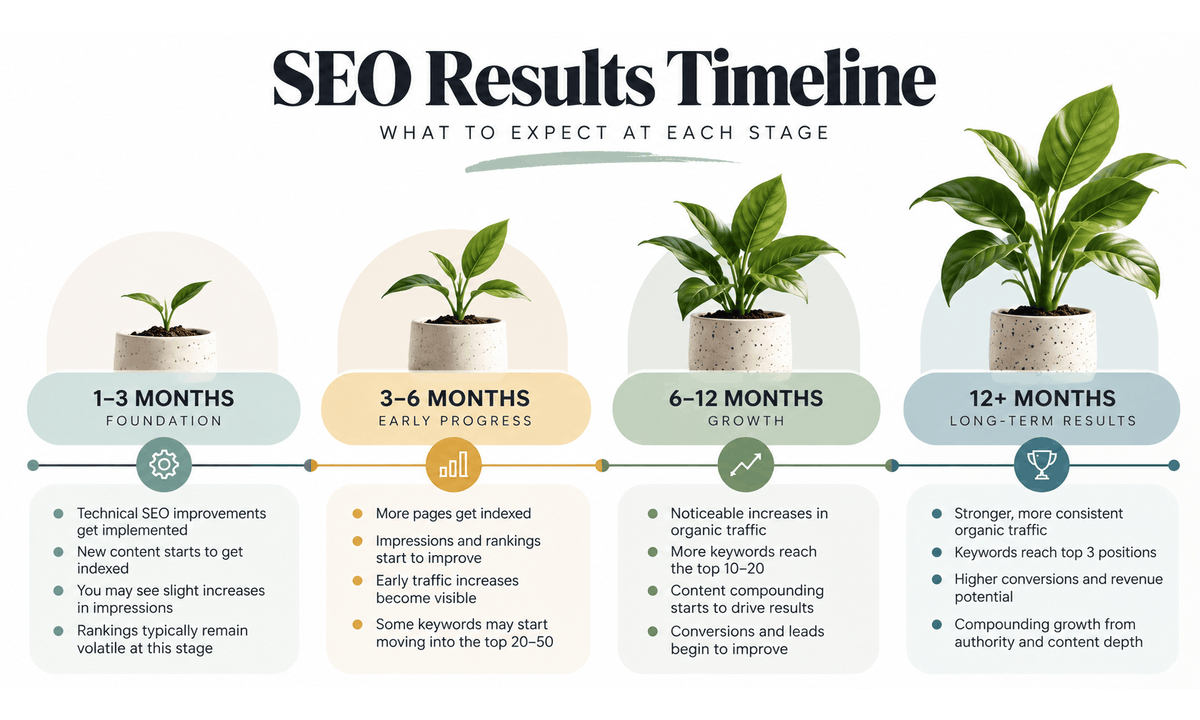
What's happening behind the scenes at each stage
While you're watching for those results, here's the work that drives them.
Foundation
Behind the scenes
Auditing and repairing technical issues, researching keywords, setting up your business listing on Google, and confirming your most important pages can be crawled and indexed.
Early progress
Behind the scenes
Upgrading service pages, publishing helpful content, adding internal links, and pushing pages that sit just off page one.
Growth
Behind the scenes
Expanding content into related topics, earning links and reviews, and refining the pages that are starting to bring in leads.
Long-term results
Behind the scenes
Defending top rankings, moving into new topics and locations, and improving conversion rates on the traffic you've earned.
Typical stages for a small or mid-sized business with an established website. New domains and highly competitive markets usually move slower.
What SEO ranking progress looks like
Rankings rarely jump straight to page one. They climb in steps, and how fast depends heavily on competition. This example compares two keywords for the same business: a low-competition local search and a competitive one.
Illustrative example of a typical pattern, not data from a specific client. Real rankings move unevenly, with plateaus and small drops along the way.
Notice that the local keyword breaks onto page one around month 7, while the competitive keyword is still on page two after a full year, which is why the timeline above stretches past 12 months. Most SEO strategies go after easier wins first to bring in traffic while the harder rankings build.
What the data says about how long rankings take
Ahrefs, one of the largest SEO data providers, has tracked how long pages take to rank since 2017. Their most recent study shows how much Google favors pages that have been around a while.
How old are the pages ranking in Google's top 10?
| Finding | Result |
|---|---|
| Top-10 pages less than 1 year old | 13.7% |
| Top-10 pages more than 3 years old | 72.9% |
| Average age of a #1-ranking page | About 5 years |
| New pages reaching the top 10 within a year | 1.74% to 6.11%, depending on the sample |
| Pages that did reach the top 10 and got there within a month | 40.82% |
Source: Ahrefs, How Long Does It Take to Rank in Google?, updated 2025, based on 1.3 million keywords and samples of 1 to 2 million newly published pages.
Most new pages never reach page one on their own. The ones that do usually have a strong site behind them, target the right keywords, and keep getting improved. SEO isn't about publishing and waiting; it's about building a site Google already trusts.
Why SEO takes time
It can feel like nothing is happening, but a lot is. These are the real reasons SEO is slower than paid ads.
Google has to find and process your changes
Every update has to be crawled and indexed before it can affect rankings, which alone can take days to weeks.
Trust is earned, not switched on
Google looks for evidence your business is credible: links from other sites, reviews, mentions, and a consistent track record. That evidence builds month by month.
You're competing with pages that have a head start
With the average #1 page about five years old, you're often up against competitors that have been building authority for years.
Content needs depth, not just one page
Google rewards sites that cover a topic thoroughly. That means a body of helpful pages, which takes time to build.
Google tests before it commits
New pages often bounce around in rankings while Google gauges how searchers respond. Stability usually comes after weeks or months.
Every fix builds on the last one
Technical fixes make content easier to rank, content makes links easier to earn, and links lift every page. The gains compound, so the early months look slow.
How long does SEO take to update after you make changes?
There's no single answer, and Google admits as much. According to its beginner SEO documentation, the delay ranges from hours for some updates to months for others, and Google suggests giving changes time before measuring their impact (Google Search Central). Before any of that, Google has to revisit the page, which on its own can happen within days or stretch past two weeks. Repeatedly submitting the same page through Search Console won't move you up the line (Google).
| Type of change | Typical time to show up | What you'll notice |
|---|---|---|
| Title tag or meta description edit | Days to a few weeks | Your new wording appears in Google after its next visit to the page |
| New page published | Days to a few weeks to index | The page appears in Search Console and starts earning impressions |
| Technical fixes | A few weeks | Fewer errors in Search Console, more pages indexed |
| Content improvements to an existing page | A few weeks to a few months | Ranking movement for the page's target keywords |
| Google Business Profile updates and reviews | Days to weeks | Changes in map pack visibility and profile views |
| New links from other websites | Weeks to months | Gradual lifts across the pages they point to |
Typical ranges based on Google's guidance and common experience. Timing varies with how often Google crawls your site.
How quickly does SEO work for your business?
Two businesses can start SEO on the same day and see results months apart. These are the factors that make the biggest difference.
| Factor | Results come faster when… | Results come slower when… |
|---|---|---|
| Website age and history | Your site has been around for years with a clean record | Your domain is brand new |
| Competition | Few strong competitors target your keywords | National brands and established sites dominate |
| Keyword targets | You target specific, local, or long-tail searches | You only target broad, high-volume terms |
| Starting point | Your site is technically sound | There are indexing, speed, or structure problems to fix first |
| Content | You publish and improve pages consistently | Content is thin or rarely updated |
| Authority | You already have links and reviews | Few other sites mention or link to you |
Signs your SEO is working (even before leads arrive)
Leads are the last thing to move. If you know what to look for, you can see progress much earlier, usually in this order:
More pages indexed
Search Console shows more of your important pages in Google's index, with fewer errors.
Rising impressions
Your pages appear in search results more often, even before people click.
Ranking movement on long-tail keywords
Specific, lower-competition searches start climbing first.
More organic clicks
As rankings reach page one, visitors start arriving from search.
Calls, forms, and sales
Traffic turns into leads, then into customers.
Ask your SEO provider to report on every one of these steps, not only leads. That way the monthly report shows real movement, and you're never left guessing whether the work is paying off.
How to get SEO results faster
You can't skip the process, but you can stop wasting time in it.
Do this
- Fix technical and indexing problems first
- Optimize your Google Business Profile and ask for reviews
- Improve pages already ranking on page two (positions 11–20)
- Target specific, local, and long-tail keywords before broad ones
- Link your pages to each other so Google finds and understands them
- Publish and update content on a steady schedule
- Run paid search while SEO builds, and use what converts to guide SEO
Avoid this
- Changing strategy every few weeks before results can show
- Buying cheap links or "instant ranking" packages
- Chasing only the most competitive keywords
- Publishing lots of thin, rushed pages
- Judging SEO by leads alone in the first few months
- Trusting anyone who guarantees a #1 ranking
Google's guidance for business owners is blunt: top placement can't be promised by anyone, and a provider who promises it is a reason to keep looking (Google Search Central).
Want to understand how SEO compares with paid social for short-term results? Read SEO vs Facebook Ads. Wondering what SEO should cost while you wait for results? See how much it costs to hire a marketing agency. And as more people search with AI tools, AI search optimization is worth building into your plan from the start.
SEO usually spends its first 3 months on the foundation, shows early progress by months 3 to 6, and delivers real results in 6 to 12. It's slower than ads, but what you build keeps working. Start now, go after the easier wins first, track the leading indicators, and give it the time it needs to compound.
Frequently asked questions
How long does SEO take to see results?
Why does SEO take so long?
How long does SEO take to update after I make changes?
How long does it take for SEO to work on a new website?
How quickly does SEO work for local businesses?
Can SEO work in 30 days?
Should I run paid ads while waiting for SEO?
When should I worry that SEO isn't working?
The best time to start SEO was last year. The next best time is now.
We'll look at where your site stands today, find the quickest wins, and give you a realistic timeline for your market, plus monthly reports that track progress long before the leads roll in.