
Google Is Changing How Your Bids Work on August 17 – Here’s What That Means for Your Campaigns
If you use a Target CPA or Target ROAS bid strategy in your Google Ads campaigns, this is one Google update you need to pay attention to.
It’s not a flashy update.
There’s no new AI chatbot or generative ad format involved.
But it could quietly change how much you’re paying per lead or per sale starting next month and Google is not going to fix it for you automatically.
Here’s the simple, no BS version of what’s changing, why it matters, and what to do about it before the deadline.
Here’s What’s Happening
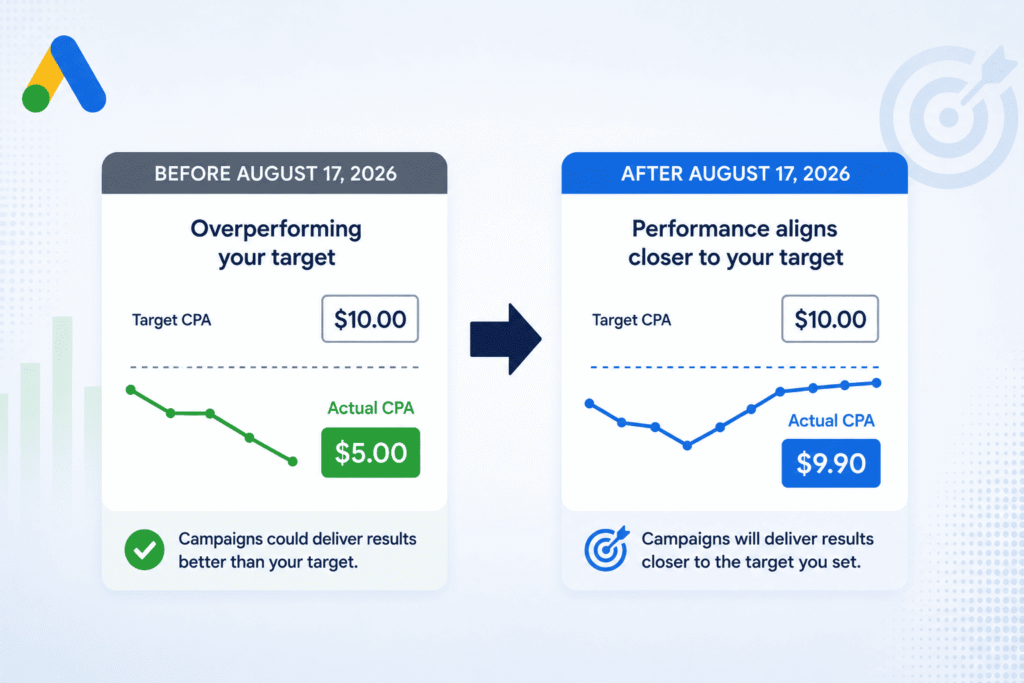
Starting August 17, 2026, Google is updating its bidding systems so that campaigns using a Target CPA or Target ROAS bid strategy deliver performance that sticks much closer to the actual target you set, even when you adjust your budget.
That sounds like a good thing, right?
But here’s the catch: if your campaigns have been quietly beating their targets, getting you a lower cost-per-lead or higher return than what you actually told Google to aim for, that “bonus” performance is going away.
Google will start pushing those campaigns to perform closer to the number you originally typed in, not the better number you’ve actually been getting.
Why This Is Happening
Right now, if a campaign is limited by budget and uses a target-based bid strategy, it can end up overperforming its stated target.
That sounds great until you try to grow it.
Increasing the budget on one of these overperforming campaigns often causes performance to fluctuate or get worse, because the system was never really optimizing toward your budget ceiling in a predictable way.
Google’s fix is to make target-based bidding behave more consistently: once this change rolls out, campaigns will optimize toward the number you actually entered, and increasing your budget should scale performance more predictably instead of causing the volatility advertisers have dealt with for years.
Let’s Look at an Example…
Picture a local plumbing company. Let’s call them Riverside Plumbing. A year ago, they set a Target CPA of $75 per lead, figuring that was the most they could pay for a phone call or form-fill and still turn a profit once you factor in job win-rate and average ticket size.
Fast forward to today: their campaign has actually been performing better than that. Because of strong reviews, a well-optimized landing page, and Google getting smarter about who to show their ads to, they’ve quietly been landing leads at closer to $45 each, well under their $75 target. Riverside never touched that number again after setting it.
Why would they? Leads were coming in cheap and the phone was ringing.
Here’s the problem: after August 17, Google’s bidding system will stop letting that $45 “bonus” performance continue by default. It will start pushing the campaign back toward the $75 target Riverside actually typed in years ago, even though $45 is what’s been working. If the owner doesn’t go in and manually lower that Target CPA to reflect what they’ve really been achieving, they could suddenly see their cost per lead nearly double, with no changes to their ads, targeting, or budget.
It’s just a quieter, more expensive version of the exact same campaign.
For a business bringing in, say, 40 leads a month, that’s the difference between spending roughly $1,800 and spending $3,000 for the same volume of calls.
Which Campaigns Are Affected
This applies to target-based bid strategies across:
- Search
- Shopping
- Performance Max
- Demand Gen
- Display and Hotel (these already use the new behavior in some cases)
- Travel
For Performance Max and Demand Gen specifically, Google has also noted that advertisers may see shifts in how traffic is distributed across channels as a result of this change, not just shifts in overall cost.
What Google Wants You to Do About It
Google isn’t leaving advertisers completely in the dark. Google is rolling out a tool inside Google Ads on July 6, 2026, that shows historical campaign performance and lets you quickly update your targets to match. If your account has had budget-limited campaigns using an affected bid strategy in the last 12 months, you should already be seeing a notification about this inside your account.
From there, you essentially have four options for each affected campaign:
- Do nothing – if your current target genuinely reflects your business goals, you can leave it as-is and accept that performance will shift toward that number.
- Match your recent performance – use the tool to lower your target to whatever you’ve actually been achieving, to preserve your current results.
- Set a custom target – pick a number in between, based on what’s actually profitable for your business rather than either extreme.
- Switch bid strategies entirely – move to Maximize Conversions or Maximize Conversion Value if you’d rather optimize for volume within your budget than hit a fixed cost target.
Google also recommends giving your budget “room to scale” once the change takes effect, since campaigns will now be able to grow more predictably without the performance swings that used to come with raising budgets on overperforming campaigns.
What This Actually Means for Your Business
Here’s the part that matters most: this change rewards accounts that are actively managed and quietly penalizes accounts that have been running on autopilot.
If your campaigns have been overperforming their targets for months, that hidden efficiency is about to disappear unless someone manually goes in, reviews the historical performance, and resets the targets before August 17.
Multiply that across every campaign in your account – Search, Shopping, PMax, Demand Gen – and this isn’t a five-minute task for most businesses. It requires:
- Auditing every budget-limited campaign using Target CPA or Target ROAS
- Comparing your set target against actual recent performance
- Deciding, campaign by campaign, whether to hold, adjust, or switch strategies entirely
- Understanding your real margins well enough to know what target actually keeps the campaign profitable
- Doing all of this before the August 17 deadline, and then monitoring closely for the following few weeks as performance settles into the new behavior
Miss this, and you could wake up in late August wondering why your cost-per-lead jumped or your return on ad spend dropped – with no obvious cause, because nothing about your ads or targeting actually changed. Only the bidding math did.
You Shouldn’t Have to Track Deadlines Like This Yourself
This is exactly the kind of update that’s easy to miss if Google Ads isn’t your full-time job and exactly the kind of thing that quietly costs businesses money when it’s missed. It’s not a headline-grabbing AI feature. It’s a technical bidding change buried in a help center article, with a hard deadline and real financial consequences.
That’s the value of having a dedicated PPC partner: someone whose job is to actually read updates like this one, audit your account before the deadline, and make the right call on every campaign – not guess after the fact why performance shifted.
Get Your Free PPC Marketing Plan
We’ll review your account, check whether this bidding change affects your campaigns, and build you a free, no-obligation plan for how to protect (and grow) your performance heading into August.

Don’t let a bidding update you never heard of quietly change your cost per lead. Let us handle it.
Already Working With an Agency? Ask Them This
If you already have someone managing your Google Ads, this update is actually a great way to find out how closely they’re really paying attention. Before August 17 rolls around, ask your current agency or in-house marketer:
- Which of our campaigns use Target CPA or Target ROAS, and are any of them limited by budget?
- Have you compared our set targets against our actual recent performance?
- Are we going to see cost or ROAS changes because of Google’s August 17 bidding update, and if so, on which campaigns?
- Have you already used the Bid Target Adjustment Tool on our account, or do you have a plan to before the deadline?
- If we do nothing, what happens to our results?
A good agency should be able to answer these clearly and specifically, ideally because they’ve already flagged this for you, not because you brought it up first. If you get a vague answer, a “we’ll look into it,” or silence, that’s worth paying attention to. This is precisely the kind of update that separates agencies who are actively managing your account from ones who set it up once and let it run.
Not loving the answers you got? Get a second opinion, free.
We’ll pull up your account, check your targets against your real performance, and give you a straight answer on whether you’re set up right for August 17. No pitch, no pressure, no obligation to switch anything.


Vanessa Lyles is the founder of eGr0wth and a digital marketing strategist obsessed with turning clicks into customers. From SEO and Google Ads to ecommerce and conversion optimization, she helps businesses stop wasting marketing dollars and start generating measurable growth.